2025 Consumer Confidence Report
Nesika Beach – Ophir Water District
Consumer Confidence Report
For Water Testing done during the calendar year of 2025
This is our annual Consumer Confidence Report for your drinking water system. We are required to keep you informed about the testing we perform on the water we have delivered to you over the past year. The most recent sampling data has been gathered for this report. We hope that you will learn more about your water quality. Our goal is and always has been, to provide to you a safe and dependable supply of drinking water.
CONSUMER CONFIDENCE REPORT SUMMARY
The Nesika Beach–Ophir Water District is committed to providing safe, reliable, and dependable drinking water to all customers. This annual Consumer Confidence Report summarizes the water quality testing completed during the 2025 calendar year and keeps customers informed about the safety of their drinking water.
Throughout 2025, the District conducted all required water quality monitoring and testing. The results showed that the drinking water met all health-based drinking water standards.
The District had only one violation during 2025, which was an administrative paperwork violation. In December 2025, two routine monthly bacterial samples were properly collected, and both samples passed testing requirements. However, only one of those sample results was submitted to the State of Oregon. This reporting issue did not affect water quality or public health, and there were no problems with the safety of the drinking water supplied to customers.
The District remains dedicated to maintaining compliance with all state and federal drinking water regulations while continuing to provide high-quality drinking water to the community.
Nesika Beach Ophir Water District
PO Box 39
Ophir, OR 97464
Phone (541) 247-2614
Fax (541) 247-9684
E-mail - nbowdistrict@gmail.com
Service Line Inventory Statement
The Nesika Beach–Ophir Water District completed an inventory of the water service lines within our distribution system in 2025 as required by the EPA and Oregon Drinking Water Services. Based on the materials identified and records reviewed, the District has determined that there are no known lead service lines or galvanized service lines requiring replacement within the public water system. The District will continue to update and maintain its service line inventory as additional information becomes available.
For more information about our service line inventory or drinking water quality, please contact the Nesika Beach–Ophir Water District office at (541) 247-2614 or visit www.nbowd.org or visit https://yourwater.oregon.gov/leadcopper.php?pwsno=00329, then click the “Service Lines” tab, and you will get the service line inventory.
WHY AM I RECEIVING THIS REPORT?
All public water systems in Oregon are regulated under Federal requirements. The United States Congress passed the Safe Drinking Water Act 25 years ago and gave the U.S. Environmental Protection Agency (EPA) the job of making rules-National Primary Drinking Water Regulations (NPDWR) - to ensure that drinking water in the U.S. is safe.
In 1996, Congress passed amendments that require drinking water systems to give consumers important information about their water. This report is brought to you in accordance with EPA’s 40 Code of Federal Regulations, NPDWR Parts 141 and 142.
If you have any questions about this report or concerning your water utility, please contact our District Manager by telephone at (541)247-2614, or in person at the district office located at 32876 Nesika Rd, Nesika Beach, OR
MONTHLY MEETINGS
Board meetings are held on the second Wednesday of each month at the district office located at 32876 Nesika Rd, Nesika Beach, OR, at 6:00 PM. All the public is welcome!
SOURCE OF WATER
The sources of drinking water include rivers, lakes, streams, ponds, reservoirs, and wells. As water travels over the surface of land or through the ground, it dissolves naturally occurring minerals and radioactive materials and can pick up substances resulting from human and animal activity.
The source of water for NBOWD is a drilled well located on District-owned property near the Rogue River on North Bank Rogue River Rd. This source of water is classified as a groundwater source. A source water assessment has been completed by the Oregon Health Authority and is available for viewing at the District Office.
Groundwater is considered one of the safest sources of water available. The State of Oregon has our system classified as a COMMUNITY system for monitoring purposes. We chlorinate the water to protect it from microorganisms while it is in the distribution system. We also add soda ash (a naturally occurring mineral) to our water to adjust the pH of the water for corrosion control
SPECIAL MESSAGE
As a reminder to all users, the district routinely flushes the main lines on the second Tuesday of every month, starting at 10:00 AM. This generally takes 4 to 6 hours. During this time, or whenever we are doing repairs, the larger-than-normal flow can create dirty water and low pressure. The district will have the lines flushed as quickly as possible. If you observe cloudy colored water during these times and it does not clear up in a very short amount of time, please contact the District Office. Beginning June, 2025, we started a public education campaign on how we can conserve water in the water district. Please continue to keep an eye out for updates.
MONITORING
NBOWD routinely monitors for contaminants in your drinking water according to Federal and State laws. This table shows the results of our monitoring for the period of January 1st, 2023, to December 31st, 2025. All drinking water, including bottled drinking water, may be reasonably expected to contain at least small amounts of some constituents. It's important to remember that the presence of these constituents does not necessarily pose a health risk. Contaminants that may be present in raw or source water before it is treated may include microbial contaminants, inorganic contaminants, pesticides and herbicides, radioactive contaminants, and organic chemical contaminants.
Microbial contaminants, such as bacteria and viruses, may come from septic systems, animal feedlots, and wildlife. Inorganic contaminants, such as salts and metals, can be naturally occurring in groundwater and can also come from run-off, mining, farming, or sewage discharges. Pesticides and herbicides can come from a variety of places, such as agricultural and domestic uses. Radioactive contaminants are naturally occurring. Organic chemical contaminants, including synthetic and organic volatile chemicals, many of which are by-products of industrial processes, can come from improper use and disposal, gas stations, and sewage disposal systems.
MORE ABOUT WATER
All drinking water, including bottled water, may reasonably be expected to contain at least small amounts of some contaminants. The presence of contaminants does not necessarily indicate that the water poses a health risk. More information about contaminants and potential health effects can be obtained by calling the Environmental Protection Agency’s Safe Drinking Water Hotline at 1-800-426-4791.
DEFINITIONS
In this report, you will find many terms and abbreviations you might not be familiar with. To help you better understand these terms we have provided the following definitions:
Non-Detects (ND) - laboratory analysis indicates that the constituent is not present.
Parts per million (ppm) or Milligrams per liter (mg/l) - one part per million corresponds to a single penny in $10,000.
Parts per billion (ppb) or Micrograms per liter - one part per billion corresponds to a single penny in $10,000,000.
Action Level - the concentration of a contaminant which, if exceeded, triggers treatment or other requirements that a water system must follow.
Maximum Contaminant Level - The Maximum Allowed (MCL) is the highest level of a contaminant that is allowed in drinking water. MCLs are set as close to the MCLGs as feasible using the best available treatment technology.
Maximum Contaminant Level Goal - The Maximum Allowed (MCLG) is the level of a contaminant below which there is no known or expected health risk.
Pesticide – A substance used for destroying insects or other organisms harmful to cultivated plants or animals.
Herbicide – A substance that is toxic to plants, used to destroy unwanted vegetation.
Contaminant – A polluting or poisonous substance that makes something impure.
PFAS- Per and Polyfluoroalkyl substances, a large group of human-made chemicals often called “forever chemicals” because they break down extremely slowly in the environment and in the human body.
ARE THERE CONTAMINANTS IN THE NBOWD WATER?
The Oregon Health Authority Drinking Water Program directs NBOWD on testing and monitoring. The full list of testing we conduct and the testing results are posted on yourwater.oregon.gov, and you can search by our system identification number 00329. The following are the routine tests we do at NBOWD:
Bacteria- 2 samples per month- No detections of E. coli or coliform bacteria in our finished water.
Source Assessment – 1 bacteria sample per year from the well. No E. coli detection.
Nitrates- One test per year; Very low-level detection.
Disinfection by-Products – Tested annually at the furthest ends of the distribution system during the summer months.
Chlorine, pH, and alkalinity are tested daily. Levels are maintained to meet State required levels.
In 2022 and 2025, we tested for many chemicals, most of which were not detected (ND) in our water. The table below identifies the results where testing showed the chemical present, all of which were at very low levels.
Inorganic Chemicals- We test every 9 years for 12 contaminants; last done 9/19/22.
Synthetic and Volatile Organic contaminants- tested every 3 years for 83 contaminants; last done 7/26/22, 9/19/22, 8/12/25, and 10/6/25.
Radiological - One test every nine years - last done 7/26/22.
Asbestos- One test required every nine-year monitoring period. Last done 10/5/20
Arsenic - One test every nine years - Last done 9/19/22
Nitrite - One test every nine years - Last done 9/19/22
Lead and Copper- Tap samples at various locations are taken every 3 years to meet corrosion control testing requirements. Last done 8/12/25, Next testing July 2028.
Below are listed the detections that were found during testing- They do not necessarily present a health risk. Only Detected Chemicals are listed in this table- if they are not listed, they were not detected - ND!
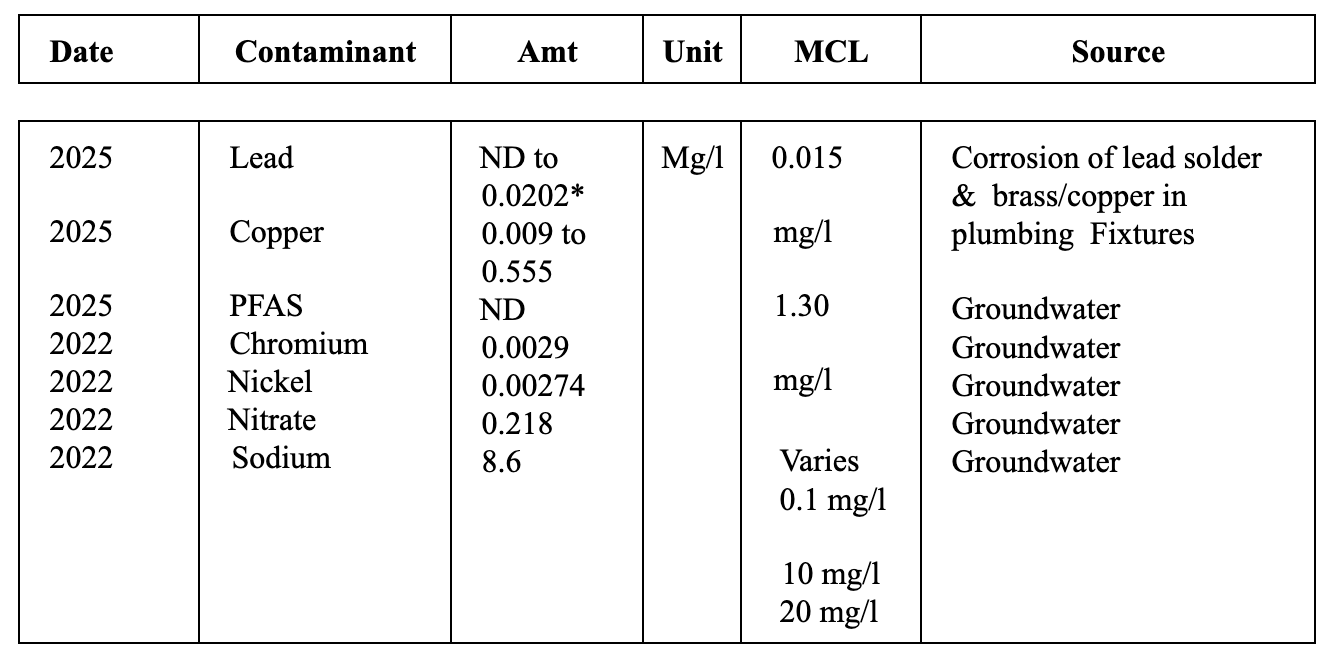
*As shown in the table above, our water system had Action level exceedance for detected contaminants. The only elevated result was for lead at one residential home out of the 10 homes tested. That home tested slightly above the lead action level of 0.015 mg/L, with a result of 0.0202 mg/L.
One residential sample exceeded the EPA lead action level of 0.015 mg/L with a result of 0.0202 mg/L. Follow-up evaluation indicates the source is likely related to plumbing materials within the residence and not the district distribution system. The District continues to maintain corrosion control treatment and monitoring requirements.
IMPORTANT HEALTH INFORMATION
Some people may be more vulnerable to contaminants in drinking water than the general population. Immunocompromised persons, such as persons with cancer undergoing chemotherapy, persons who have undergone organ transplants, people with HIV/AIDS or other immune system disorders, some elderly, and infants, can be particularly at risk from infections. These people should seek advice about drinking water from their healthcare providers. EPA/CDC guidelines on appropriate means to lessen the risk of infection by cryptosporidium and other microbiological contaminants are available from the Safe Drinking Water Hotline (800-426-4791). Additionally, some elderly and infants can be particularly at risk of infections. These people should seek advice about drinking water from their healthcare providers. EPA/CDC guidelines on appropriate means to lessen the risk of infection by cryptosporidium and other microbiological contaminants are available from the Safe Drinking Water Hotline (800-426-4791).